

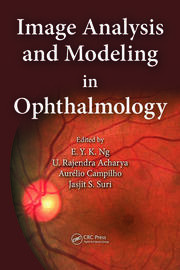
1st Edition
Image Analysis and Modeling in Ophthalmology

Digital fundus images can effectively diagnose glaucoma and diabetes retinopathy, while infrared imaging can show changes in the vascular tissues. Likening the eye to the conventional camera, Image Analysis and Modeling in Ophthalmology explores the application of advanced image processing in ocular imaging. This book considers how images can be used to effectively diagnose ophthalmologic problems. It introduces multi-modality image processing algorithms as a means for analyzing subtle changes in the eye. It details eye imaging, textural imaging, and modeling, and highlights specific imaging and modeling techniques.
The book covers the detection of diabetes retinopathy, glaucoma, anterior segment eye abnormalities, instruments on detection of glaucoma, and development of human eye models using computational fluid dynamics and heat transfer principles to predict inner temperatures of the eye from its surface temperature. It presents an ultrasound biomicroscopy (UBM) system for anterior chamber angle imaging and proposes an automated anterior segment eye disease classification system that can be used for early disease diagnosis and treatment management. It focuses on the segmentation of the blood vessels in high-resolution retinal images and describes the integration of the image processing methodologies in a web-based framework aimed at retinal analysis.
The authors introduce the A-Levelset algorithm, explore the ARGALI system to calculate the cup-to-disc ratio (CDR), and describe the Singapore Eye Vessel Assessment (SIVA) system, a holistic tool which brings together various technologies from image processing and artificial intelligence to construct vascular models from retinal images. The text furnishes the working principles of mechanical and optical instruments for the diagnosis and healthcare administration of glaucoma, reviews state-of-the-art CDR calculation detail, and discusses the existing methods and databases.
Image Analysis and Modeling in Ophthalmology
includes the latest research development in the field of eye modeling and the multi-modality image processing techniques in ocular imaging. It addresses the differences, performance measures, advantages and disadvantages of various approaches, and provides extensive reviews on related fields.Ultrasound Biomicroscopic Imaging of the Anterior Chamber Angle
Maria Cecilia Aquino and Paul Chew
Automated Glaucoma Identification Using Retinal Fundus Images: A Hybrid Texture Feature Extraction Paradigm
Muthu Rama Krishnan Mookiah, U Rajendra Acharya, Chandan Chakraborty, Lim Choo Min, Eddie Y K Ng, and Jasjit S Suri
Ensemble Classification Applied to Retinal Blood Vessel Segmentation: Theory and Implementation
Muhammad Moazam Fraz and Sarah A Barman
Computer Vision Algorithms Applied to Retinal Vessel Segmentation and Quantification of Vessel Caliber
Muhammad Moazam Fraz and Sarah A Barman
Segmentation of the Vascular Network of the Retina
Ana Maria Mendonça, Behdad Dashtbozorg, and Aurélio Campilho
Automatic Analysis of the Microaneurysm Turnover in a Web-Based Framework for Retinal Analysis
Noelia Barreira, Manuel G Penedo, Sonia González, Lucía Ramos, Brais Cancela, and Ana González
A-Levelset-Based Automatic Cup-to-Disc Ratio Measurement for Glaucoma Diagnosis from Fundus Image
Jiang Liu, Fengshou Yin, Damon Wing Kee Wong, Zhuo Zhang, Ngan Meng Tan, Carol Cheung, Mani Baskaran, Tin Aung, and Tien Yin Wong
The Singapore Eye Vessel Assessment System
Qiangfeng Peter Lau, Mong Li Lee, Wynne Hsu, and Tien Yin Wong
Quantification of Diabetic Retinopathy Using Digital Fundus Images
Hasan Mir, Hasan Al-Nashash, and U Rajendra Acharya
Diagnostics Instruments for Glaucoma Detection
Teik-Cheng Lim, U Rajendra Acharya, Subhagata Chattopadhyay, Jasjit S Suri, and Eddie Y K Ng
Automated Cup-to-Disc Ratio Estimation for Glaucoma Diagnosis in Retinal Fundus Images
Irene Fondón, Carmen Serrano, Begoña Acha, and Soledad Jiménez
Arteriovenous Ratio Calculation Using Image-Processing Techniques
Manuel G Penedo, Sonia González, Noelia Barreira, Marc Saez, Antonio Pose-Reino, and María Rodríguez-Blanco
Survey on Techniques Used in Iris Recognition Systems
Nagarajan Malmurugan, Shanmugam Selvamuthukumaran, and Sugadev Shanmugaprabha
Formal Design and Development of an Anterior Segment Eye Disease Classification System
Oliver Faust, Chan Wei Yan, Muthu Rama Krishnan Mookiah, U Rajendra Acharya, Eddie Y K Ng, and Wenwei Yu
Modeling of Laser-Induced Thermal Damage to the Retina and the Cornea
Mathieu Jean and Karl Schulmeister
Automatization of Dry Eye Syndrome Tests
Manuel G Penedo, Beatriz Remeseiro, Lucía Ramos, Noelia Barreira, Carlos García-Resúa, Eva Yebra-Pimentel, and Antonio Mosquera
Thermal Modeling of the Ageing Eye
Anastasios Papaioannou and Theodoros Samaras
A Perspective Review on the Use of In Vivo Confocal Microscopy in the Ocular Surface
Sze-Yee Lee, Andrea Petznick, Shakil Rehman, and Louis Tong
Computational Modeling of Thermal Damage Induced by Laser in a Choroidal Melanoma
José Duarte da Silva, Alcides Fernandes, Paulo Roberto Maciel Lyra, and Rita de Cássia Fernandes de Lima
Index
Biography
E Y K Ng, received his PhD at Cambridge University. He is a faculty member at the Nanyang Technological University in the School of Mechanical and Aerospace Engineering. Ng is editor-in-chief for the J. of Mechanics in Medicine and Biology and J. Med. Imaging and Health Informatics; assoc. editor for Int. J. of Rotating Machinery, Computational Fluid Dynamics J., Int. J. of Breast Cancer, Chinese J. of Medicine, Open Medical Informatics J., Open Numerical Methods J., and J. of Healthcare Engineering; and strategy assoc. editor-in-chief for World J. of Clinical Oncology. Ng has published more than 255 SCI journal papers, and co-edited 11 books including Human Eye Imaging and Modeling by CRC (2011).
U. Rajendra Acharya, PhD, DEng is a visiting faculty in Ngee Ann Polytechnic, Singapore. He is also an adjunct professor at the University of Malaya, Malaysia; adjunct faculty in Singapore Institute of Technology-University of Glasgow, Singapore; associate faculty in SIM University, Singapore; and adjunct faculty in Manipal Institute of Technology, Manipal, India. He received his Ph.D. from the National Institute of Technology Karnataka, Surathkal, India and D Engg from Chiba University, Japan. He has published more than 275 papers in refereed international SCI-IF journals, international conference proceedings, textbook chapters, and books. His major interests are in biomedical signal processing, bio-imaging, data mining, visualization, and biophysics.
Aurélio Campilho, is a full professor in the Department of Electrical and Computer Engineering, Faculty of Engineering, University of Porto (FEUP), Portugal. He served as president of the Biomedical Engineering Institute, as director of the doctoral program in Electrical and Computer Engineering at FEUP, and as a member of the Scientific Committee of the Master Degree in Bioengineering at the University of Porto. His current research interests include the areas of medical image analysis, image processing, and computer vision. He served as associate editor of the journals IEEE Transactions on Biomedical Engineering and of the Machine Vision Applications journal. He authored one book, co-edited 12 books, and published more than 150 papers in journals and conferences.
Jasjit S. Suri, MS, PhD, MBA, Fellow AIMBE, has spent over 25 years in the field of biomedical engineering/sciences and its management. He received his masters from University of Illinois, Chicago, doctorate from University of Washington, Seattle, and executive management education from Weatherhead School of Management, Case Western Reserve University, Cleveland. Dr. Suri has written over 350 peer-reviewed publications, and is a committee member of several journals and companies. Dr. Suri was crowned with the President’s Gold medal in 1980 and the Fellow of American Institute of Medical and Biological Engineering (AIMBE), awarded by National Academy of Sciences, Washington DC in 2004.