

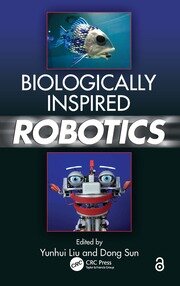
Robotic engineering inspired by biology—biomimetics—has many potential applications: robot snakes can be used for rescue operations in disasters, snake-like endoscopes can be used in medical diagnosis, and artificial muscles can replace damaged muscles to recover the motor functions of human limbs. Conversely, the application of robotics technology to our understanding of biological systems and behaviors—biorobotic modeling and analysis—provides unique research opportunities: robotic manipulation technology with optical tweezers can be used to study the cell mechanics of human red blood cells, a surface electromyography sensing system can help us identify the relation between muscle forces and hand movements, and mathematical models of brain circuitry may help us understand how the cerebellum achieves movement control.
Biologically Inspired Robotics contains cutting-edge material—considerably expanded and with additional analysis—from the 2009 IEEE International Conference on Robotics and Biomimetics (ROBIO). These 16 chapters cover both biomimetics and biorobotic modeling/analysis, taking readers through an exploration of biologically inspired robot design and control, micro/nano bio-robotic systems, biological measurement and actuation, and applications of robotics technology to biological problems.
Contributors examine a wide range of topics, including:
- A method for controlling the motion of a robotic snake
- The design of a bionic fitness cycle inspired by the jaguar
- The use of autonomous robotic fish to detect pollution
- A noninvasive brain-activity scanning method using a hybrid sensor
- A rehabilitation system for recovering motor function in human hands after injury
- Human-like robotic eye and head movements in human–machine interactions
A state-of-the-art resource for graduate students and researchers.
Introduction to Biologically Inspired Robotics. CPG-Based Control of Serpentine Locomotion of a Snake-Like Robot. Analysis and Design of a Bionic Fitness Cycle. Human-Inspired Hyperdynamic Manipulation. A School of Robotic Fish for Pollution Detection in Port. Development of a Low-Noise Bio-Inspired Humanoid Robot Neck. Automatic Single-Cell Transfer Module. Biomechanical Characterization of Human Red Blood Cells with Optical Tweezers. Nanorobotic Manipulation for a Single Biological Cell. Measurement of Brain Activity Using Optical and Electrical Methods. Bowel Polyp Detection in Capsule Endoscopy Images with Color and Shape Features. Classification of Hand Motion Using Surface EMG Signals. Multifunctional Actuators Utilizing Magnetorheological Fluids for Assistive Knee Braces. Mathematical Modeling of Brain Circuitry during Cerebellar Movement Control. Development of Hand Rehabilitation System Using Wire-Driven Link Mechanism for Paralysis Patients. A Test Environment for Studying the Human-Likeness of Robotic Eye Movements. Index.
Biography
Yunhui Liu, Dong Sun