


1st Edition
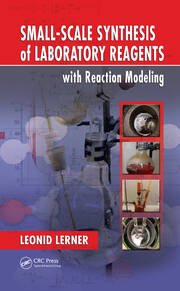
Small-Scale Synthesis of Laboratory Reagents with Reaction Modeling

The in-lab preparation of certain chemical reagents provides a number of advantages over purchasing various commercially prepared samples. This is especially true in isolated regions where acquiring the necessary substances from overseas can cause undue delay and inconvenience due to restrictions on the transportation of hazardous chemicals. An invaluable resource for chemists in a variety of environments, Small-Scale Synthesis of Laboratory Reagents with Reaction Modeling presents efficient, sensible, and versatile methods for the laboratory preparation of common chemical reagents.
Rapid, reliable synthesis
Designed to facilitate smooth experimentation in the lab, this volume presents preparations chosen for their short duration, availability of apparatus, high yield, and high purity of the product. Adding an educational component, the book also discusses fundamental processes in inorganic chemistry, presenting original modeling of reactions and their practical implementation. Theoretical aspects are discussed to a greater extent than is usual in synthetic literature in cases where there is a direct impact on experimental parameters, such as the reaction time, yield, and purity of the product.
More than 30 convenient, time-saving preparations
Focusing on simple synthesis of high-purity reagents, the book contains over 30 presentations, a substantial number of which are mathematically modeled for the first time. Most syntheses can be carried out in one day using common laboratory equipment, making this volume a valuable and time-saving tool.
Safety in the Laboratory. Sodium. Potassium. Lithium. Cesium. Lithium Hydride and Sodium Hydride. Bromine. Aluminum Bromide. Lithium Aluminum Hydride. Triethylaluminum and Diethylaluminum Bromide. Hydrazine Sulfate and Alcoholic Hydrazine Hydrate. Sodium and Potassium Azide. Potassium t-Butoxide and Potassium Hydride. Carbon Disulfide. Chlorine. Carbon Tetrachloride. Bis-Trichloromethyl Carbonate (Triphosgene). Phosphorus Pentachloride. Phosphorus Oxychloride. Sulfur Trioxide and Oleum. Thionyl Chloride and Chlorosulfonic Acid. Appendix: Assay of Reagents.
Biography
Graduating with a BSc (Hons.) in 1984 and a MSc in 1985 from the Victoria University of Wellington, Leonid Lerner obtained his PhD in physics from Cambridge University, UK, in 1989. From 1990–1993 he was a postdoctoral fellow at the Optical Science Centre and Laser Physics Centre of the Australian National University (ANU), and a lecturer in Physics ANU 1994–1996. Leonid has worked in a number of different fields in the natural sciences and has published in a range of scientific disciplines. Currently he is a research scientist at the Defence Science and Technology Organisation, Adelaide, and Honorary Fellow at the School of Chemical and Physical Sciences, Flinders University, Adelaide.