
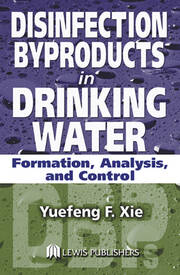
Disinfection Byproducts in Drinking Water: Formation, Analysis, and Control
Yuefeng Xie, Pennsylvania State University, Middletown, USA
Related Titles
Aquatic Chemistry Concepts
James F. Pankow, Oregon Graduate Institute, Beaverton, OR, USA
Publication Date: July 24, 1991
Price: $106.95
Environmental Engineers' Handbook, Second Edition
Editor(s):  David H.F. Liu, Seattle, Washington, USABela G. Liptak, Liptak Associates, Stamford, Connecticut, USA
Publication Date: August 29, 1997
Price: $219.95
Ozone Reaction Kinetics for Water and Wastewater Systems
Fernando J. Beltran, Universidad de Extremadura, Badajoz, Spain
Publication Date: December 29, 2003
Price: $184.95
Conversion to On-Site Sodium Hypochlorite Generation: Water and Wastewater Applications
Leonard Casson, University of Pittsburgh, Pittsburgh, Pennsylvania, USA; Jim Bess, Sugarland, Texas, USA
Publication Date: December 17, 2002
Price: $199.95
Ultraviolet Light in Water and Wastewater Sanitation
Willy J. Masschelein, Consultant, Brussels, Belgium; Rip G. Rice, Consultant, Ashton, Maryland, USA
Publication Date: April 26, 2002
Price: $139.95
Ozone in Water Treatment: Application and Engineering
Am Water Works Res F; Bruno Langlais; David A. Reckhow, University of Massachusetts; Deborah R Brink
Publication Date: February 13, 1991
Price: $219.95
Drinking Water and Infectious Disease: Establishing the Links
Editor(s):  Paul Raymond Hunter, University of East Anglia, Norwich, UKMichael Waite, Drinking Water Inspectorate, London, UKElettra Ronchi, Organization for Economic Cooperation and Development, Paris
Publication Date: July 30, 2002
Price: $194.95
Cyanobacterial Toxins of Drinking Water Supplies
Ian Robert Falconer
Publication Date: December 20, 2004
Price: $162.95
Price:  $184.95
Cat. #:  TX69744
ISBN:  9781566769747
ISBN 10:  1566769744
Publication Date:  August 27, 2003
Number of Pages:  176
Availability:  In Stock
Binding(s):  Hardback | Available in e-book!

Email this title to a friend


Description
Table of Contents
Features
  • Shows how to detect, analyze, and control disinfection byproducts in water
  • Presents basic chemistry of how DBPs are formed in water systems
  • Discusses inorganic DBPs, such as bromate and chlorite
  • Furnishes techniques for laboratory analysis
  • Reviews information resources for disinfection byproducts, including books, web pages, video tapes, journals, and conferences
  • Offers guidance for meeting regulations, including Stage I and II Disinfection Byproducts Rules

  • Summary
    The EPA has established regulations which classify four types of disinfection byproducts - TTHMs, haloacetic acids, bromate, and chlorite - and requires public water systems limit these byproducts to specific levels. Most of the information required to comply with these standards is either scattered throughout the literature or derived from conferences or symposiums. Disinfection Byproducts in Drinking Water: Formation, Analysis, and Control pulls all the information together to provide a needed organized presentation of disinfection byproduct analysis, formation, and control.

    The author begins with an introduction to all disinfection byproducts (DBPs), including their nomenclatures, molecular structures, and formation. He discusses the effects of various water quality parameters on the formation and stability of DBPs in drinking water. He further examines DBP degradation reactions, the effects of various water treatment processes on the formation and removal of DBPs, various technologies for DBP removal and control in drinking water, and the formation and control of inorganic DBPs. The text also reviews past, current, and future regulations, as well as current analytical methods and data evaluation for disinfection byproducts monitoring.

    Bringing together the findings of many notable researchers in the field, Disinfection Byproducts in Drinking Water serves as a practical guide to understanding the formation of disinfection byproducts and explaining how they are analyzed and controlled. Chemists in plants and laboratories will value the analytical techniques offered in the book, and plant engineers will benefit from the formation and control information.