
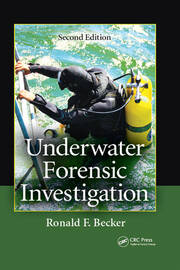

Underwater Forensic Investigation, Second Edition

Underwater Forensic Investigation, Second Edition

Published:
Author(s):
Free Standard Shipping

Purchasing Options

Hardback
$99.95
Add to cart
ISBN 9781466507500
Cat# K14674
eBook
ISBN 9781466507517
Cat# KE16181
 

Features

    • Presents the most comprehensive underwater CSI guide available
    • Summarizes history, physics, and laws applicable to underwater investigations
    • Provides nearly 100 color illustrations
    • Includes new chapters on photography, contaminated sites, preservation of evidence, and releasing the crime scene
    • Contains expanded chapters on death investigation and organizing the dive team

    Summary

    The evidence discovered at underwater crime scenes must be handled with the same attention to proper chain of custody procedures as with any other type of investigation. Improper handling of these scenes can lead to evidence being lost, unrecognizable, destroyed, contaminated, or rendered inadmissible at the time of trial. Updated and expanded, Underwater Forensic Investigation, Second Edition presents a comprehensive approach to the processing of an underwater crime scene and the steps necessary to conduct the operation.

    The book summarizes the history, physics, and laws applicable to underwater investigations and includes topics such as team formation, roles, deployment, and accountability. Explaining procedures that can make a true difference in the final outcome of water-related incidents, the author also debunks myths associated with submerged evidence.

    This second edition contains several new chapters on photography, contaminated sites, preservation of evidence, and release of the crime scene, and includes expanded information on death investigation and organizing the dive team. Nearly 100 color illustrations supplement the text.

    The science of water-related investigations is still in its infancy, and hence, the field needs accurate and useful sources of education. This text will assist law enforcement professionals and those in other areas of public safety in gaining the knowledge that has historically been lacking. The incorporation of the procedures presented will enable those tasked with working these scenes to develop a greater degree of professionalism, objectivity, thoroughness, and accuracy relating to the investigation of water-related incidents—increasing the chance for successful resolution of these difficult cases.

    Table of Contents

    Introduction
    New Words and Concepts
    Student Learning Outcomes
    Man and the Sea
    Law Enforcement and Underwater Evidence
    Myth 1
    Myth 2
    Myth 3
    Myth 4
    Myth 5
    Myth 6
    Myth 7
    Myth 8
    Myth 9
    Myth 10
    A Brief History of Underwater Investigation
    New Words and Concepts
    Learning Outcomes
    Diving History
    Diving Dress
    Caisson Disease
    The Cause of Decompression Sickness
    Nitrogen Narcosis
    Self-Contained Underwater Breathing Apparatus
    Underwater Investigation
    Some Important Dates in the History of SCUBA Diving
    An Explanation of Pressure and the Laws of Boyle, Charles, Dalton, and Henry
    New Words or Concepts
    Student Learning Outcomes
    Recognize Charles Law
    Nitrogen Narcosis
    Decompression Sickness
    Oxygen Toxicity
    The Underwater Forensic Investigator
    New Words and Concepts
    Learning Outcomes
    Introduction
    Beginning Perspectives
    Standardized Selection and Operations
    Swimming Skills
    Diving Skills
    Incident Command Structure
    Incident Commander
    Dive Team Coordinator
    Public Information Officer
    Incident Safety Officer
    Team Structure
    Dive Team Coordinating Board
    Team Members
    Team Leader
    Tenders
    Divers
    Intelligence Officer
    Photographer
    Lift Specialists
    Equipment Specialist
    Archivist
    Medical Officer
    Training Coordinator
    The Law of Search and Seizure
    New Words and Concepts
    Learning Outcomes
    The U.S. Constitution and Due Process
    The Fourth Amendment
    The Fifth Amendment
    The Sixth Amendment
    The Exclusionary Rule
    History
    Exceptions
    Emergency Searches
    Warrantless Searches Based on Reasonableness
    Consent Searches
    Plain-View Searches
    Open-Field Exception
    The Underwater Crime Scene
    New Words and Concepts
    Student Learning Outcomes
    Introduction
    Search Briefing
    Bottom Structure
    Current
    Surf, Waves, and Tide
    Perimeter Marking
    Boat Searches
    Search Patterns
    Random Search
    Sweep Searches
    Parallel Searches
    Circular Search
    Snag Search
    River Search
    Relocating the Search Site
    Profiling
    Temporal and Geographical Location of Evidence
    Establishing a Reference Point
    Crime Scene Measurements
    Orienting Evidence
    Grid Searches
    The Underwater Crime Scene Sketch
    Handling Evidence
    The Press
    Underwater Photography
    New Words and Concepts
    Student Learning Outcomes
    Introduction
    Equipment
    Taking Pictures Underwater
    Photographic Log
    Video-Recording Log
    Photographing the Underwater Crime Scene
    Video Recording
    Logging Photos
    Medicolegal Aspects of Underwater Death
    New Words and Concepts
    Student Learning Outcomes
    Introduction
    Unattended Water Deaths
    Body Recovery
    Identification of Submerged Bodies
    Postmortem Changes
    Putrefaction
    Algor Mortis
    Rigor Mortis
    Ocular Changes
    Livor Mortis (Postmortem Lividity)
    Errors in Interpreting Postmortem Changes
    Postmortem Interval
    Drowning
    Anthropophagi (Marine Depredation)
    Antemortem, Postmortem, and Perimortem Injuries
    Mass Disasters
    Firearms Recovery and Investigation
    New Words and Concepts
    Student Learning Outcomes
    Introduction
    Recovering Firearms
    Firearms Investigation
    Fingerprints
    Ballistics Testing
    Weapon Identification
    Firearm Identification
    National Integrated Ballistics Information Network
    Equipment
    Types of Firearms
    The Firing Mechanism
    Types of Bullets
    Propellants
    Primers
    Cartridge Cases
    Shotshells
    The Early History of the Examination of Firearms
    Examination of Weapons
    Examination of Bullets
    Caliber
    Rifling Twists
    Land and Groove Width
    Bullet Comparisons
    Examination of Cartridge Cases
    Examination Objectives
    Legal Aspects
    Class Characteristics
    Cartridge Evidence
    Chain of Custody
    Expert Testimony
    Aircraft and Vehicle Investigations
    New Words and Concepts
    Student Learning Outcomes
    Introduction
    Locating the Aircraft
    Measuring the Debris Field
    Handling Evidence
    Aircraft Recovery
    Vehicle Investigations
    Vehicular Drownings
    Vehicle Recoveries
    Recovery Checklist
    Vessel Recoveries
    New Words and Concepts
    Student Learning Outcomes
    Introduction
    Nautical Terms and Measurement
    Contents xi
    Boat Accident Investigation
    Propeller Injuries
    Boat Accident Report
    Boat Data
    Accident Data
    Vessel Fire
    Arson
    Vessel Explosions
    Arson or Detonation Checklist
    Light Filaments
    Preparing Dive Teams for Major Investigations
    Equipment
    New Words and Concepts
    Student Learning Outcomes
    Introduction
    Dry Suits
    Dive Helmets
    Tether Harnesses
    Buoyancy Control Devices
    Buoyancy
    Lifting Buoyancy
    Alternative Air Supply
    Face Masks
    Regulators, Gauges, and Computers
    Diver: From Top to Bottom
    Support Personnel
    Review Questions
    References
    Diving in Contaminated Water
    New Words and Concepts
    Student Learning Outcomes
    Introduction
    Biological Contaminants
    Chemical Contaminants
    Contaminated Water Equipment
    Using Experts and Evidence in the Courtroom
    New Words and Concepts
    Learning Outcomes
    Introduction
    Preparing for Trial
    Identification
    Chain of Custody
    Authentication
    Photographs
    Diagrams, Maps, Plats
    Video Recordings
    Physical Evidence
    Multiple Predicates
    The Underwater Investigator as an Expert Witness
    Scientific Evidence
    Defense Lawyers, Prosecutors, and Investigators
    New Words and Concepts
    Student Learning Outcomes
    Introduction
    Defensive Burden
    Affirmative Defenses
    Defense Strategies
    Suppression Hearings
    The Prosecution
    Jurisdiction
    Venue
    In-Court Identification
    Elements of the Offense
    Testimonial Devices to Avoid the Truth
    Error-Free Investigations
    Ethical Testimony
    Index

    Author Bio(s)

    Professor Becker completed his studies for a Bachelor of Science degree in Police Science at Sam Houston State University in 1969. He went on to finish his Masters Degree in Curriculum and Instruction at Texas Agricultural & Mechanical University in 1972. A short hiatus from higher education found him with The Mineral County Montana Sheriff’s Office culminating his work there as a criminal investigator and leaving for St. Mary’s Law School in 1981.

    Upon completion of his law studies and passing the Texas Bar Examination in 1983, he became a partner in the general litigation firm of Gish, Radtke, and Becker in Boerne, Texas. The firm became a successful personal injury litigation practice. During that time, Professor Becker served as the Boerne Municipal Court Judge, County Judge, and Juvenile Court Judge.

    In 1991, he began a teaching career at Texas State University in the Criminal Justice Department. In 1994, he created a facility for training public safety divers in underwater investigation based on a forensic protocol. As director of the Underwater Institute, he started the Texas State University Underwater Institute’s Annual Public Safety Diver Seminar and Competition. This annual event drew recovery divers from all over the country and was held at Texas State University in San Marcos, Texas, each year during Spring Break.

    As a tenured Full Professor, he has published four books and four editions to this criminal investigation text. During his tenure, he has published numerous articles and textbook chapters.

    Ron began work at Chaminade University on July 8, 2002 as Chair for the Criminology and Criminal Justice Program. Since that time, he has streamlined the graduate and undergraduate curricula, created an on-line Masters of Criminal Justice Administration tract and a MSCJA specialty tract in Homeland Security as a Partnership School with the Naval Post Graduate School. He was promoted to full professor in the fall of 2006. He has worked as an underwater recovery consultant for the Honolulu Police Department and the Department of Land and Natural Resources. Each summer he conducts a workshop in "Underwater Forensic Investigation". Professor Becker is a member of the Hawaii Emergency Preparedness Executive Consortium and an advisory board member for the Hawaii Law Enforcement Memorial.

    Related Titles

     
    Textbooks
    Other CRC Press Sites
    Featured Authors
    STAY CONNECTED
    Facebook Page for CRC Press Twitter Page for CRC Press You Tube Channel for CRC Press LinkedIn Page for CRC Press Google Plus Page for CRC Press
    Sign Up for Email Alerts
    © 2013 Taylor & Francis Group, LLC. All Rights Reserved. Privacy Policy | Cookie Use | Shipping Policy | Contact Us