

1st Edition
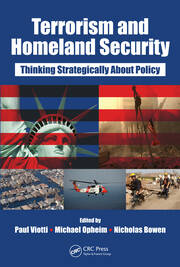
Terrorism and Homeland Security Thinking Strategically About Policy

Despite the fact that the Department of Homeland Security (DHS) has been active since November of 2002, the American homeland is still not secure from terrorist attack. What passes as DHS strategy is often just a list of objectives with vague references to the garnering of national resources, and the marshalling of support from other nations.
Drawing on the expertise of several of the nation’s leading reseachers and policy experts, Terrorism and Homeland Security: Thinking Strategically About Policy provides policymakers with a much needed starting point for the creation of an effective coherent national security strategy. Its origins pre-dating 9-11, this volume grew out of an extensive project featuring the participation of various institutions including the Army War College.
The primary goal: develop a strategy that optimizes security with minimal infringement on rights and liberties
After addressing points salient to a central strategy, the book then identifies the domestic and external elements that need to be addressed in building such a strategy. To this end, it examines the nature of terrorist threats, looks at challenges specific to various weapons of mass destruction, and then goes beyond terrorism to discuss safeguarding society and its infrastructure from natural disasters.
In concluding, the editors present a number of preliminary suggestions. It is hoped that policymakers and others may take these suggestions into account when developing a comprehensive national security strategy.
ACRONYMS
FOREWORD
THE NATIONAL SECURITY CHALLENGE: DEVELOPING STRATEGY FOR TERRORISM AND HOMELAND SECURITY.
Toward a Comprehensive Strategy for Terrorism and Homeland Security
The Search for National and Homeland Security: An Integrated Grand Strategy
Assured Vulnerability: Homeland Security and the Cold War Legacy of Defenseless
Terrorism and Deterrence by Denial
Multinational and Transnational Cooperation in Strategy to Secure the Homeland
TERRORISM, HOMELAND SECURITY AND WEAPONS OF MASS DESTRUCTION (WMD)
WMD Terrorism: New Threats, Revised Responses
Nuclear and Radioactive Threats to Homeland Security: Prevention and Response
STRATEGY AND THE SAFEGUARDING OF SOCIETY AND ITS INFRASTRUCTURE FROM TERRORISM AND OTHER THREATS
Comparative Risk Analysis: Biological Terrorism, Pandemics and Other “Forgotten” Catastrophic Disaster Threats
Homeland Security Strategy and Policy Choices: A Local Government Perspective
Democracy, Civil Society and the Damage-Limitation Component of Strategy
Transportation as a Component of Homeland Security Strategy
Redefining U.S. Energy Security in the 21st Century
CONCLUSION
Securing the Homeland
BIBLIOGRAPHY AND SUGGESTED READINGS
APPENDIX: U.S. National Strategy for Homeland Security (Executive Summary)
GLOSSARY
Biography
Paul Viotti, Michael Opheim, Nicholas Bowen