
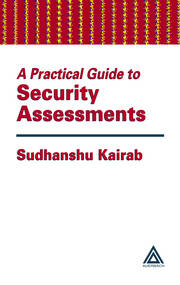

A Practical Guide to Security Assessments

A Practical Guide to Security Assessments

Published:
Author(s):
Free Standard Shipping

Purchasing Options

Hardback
$93.95
Add to cart
ISBN 9780849317064
Cat# AU1706
eBook
ISBN 9780203507230
Cat# TFE1303
 

Features

  • Provides a detailed step-by-step methodology for performing an information security assessment
  • Details the history of information security and its evolution as a discipline
  • Covers ISO 17799, COBIT, and other standards
  • Includes a HIPAA questionnaire containing questions that map to all HIPAA security requirements
  • Contains questionnaires that cover common areas of information security
  • All questionnaires contain guidance to provide the user with a detailed explanation of why a question is relevant and what some of the potential related risks are
  • Offers more than 200 questions to ask during assessments
  • Summary

    The modern dependence upon information technology and the corresponding information security regulations and requirements force companies to evaluate the security of their core business processes, mission critical data, and supporting IT environment. Combine this with a slowdown in IT spending resulting in justifications of every purchase, and security professionals are forced to scramble to find comprehensive and effective ways to assess their environment in order to discover and prioritize vulnerabilities, and to develop cost-effective solutions that show benefit to the business.

    A Practical Guide to Security Assessments is a process-focused approach that presents a structured methodology for conducting assessments. The key element of the methodology is an understanding of business goals and processes, and how security measures are aligned with business risks. The guide also emphasizes that resulting security recommendations should be cost-effective and commensurate with the security risk. The methodology described serves as a foundation for building and maintaining an information security program.

    In addition to the methodology, the book includes an Appendix that contains questionnaires that can be modified and used to conduct security assessments.

    This guide is for security professionals who can immediately apply the methodology on the job, and also benefits management who can use the methodology to better understand information security and identify areas for improvement.

    Table of Contents

    INTRODUCTION

    EVOLUTION OF INFORMATION SECURITY
    Distributed Systems
    Business-to-Business (B2B) Relationships
    Remote Access
    Enterprise Resource Planning (ERP)
    Information Security Today
    Why Protect Information Assets
    Growing Role of Internal Audit
    Security Standards
    Organizational Impacts
    Security Certifications
    Trends in Information Security

    INFORMATION SECURITY PROGRAM AND HOW SECURITY ASSESSMENTS FIT IN
    What is an Information Security Program
    How Does a Security Assessment Fit In
    Why Conduct a Security Assessment
    Security Assessment Process
    Executive Summary

    PLANNING
    Define Scope
    Staffing
    Kickoff Meeting
    Develop Project Plan
    Set Client Expectations
    Executive Summary

    INITIAL INFORMATION GATHERING
    Gather Publicly Available Information
    Gather Information from the Client
    Analyze Gathered Information
    Prepare Initial Question Sets
    Develop and Document Template for Final Report
    Executive Summary

    BUSINESS PROCESS EVALUATION
    General Review of Company and Key Business Processes
    Finalize Question Sets for Process Reviews
    Meet with Business Process Owners
    Analyze Information Collected and Document Findings
    Status Meeting with Client
    Potential Concerns During This Phase
    Executive Summary
    TECHNOLOGY EVALUATION
    General Review of Technology and Related Documentation
    Develop Question Sets for Technology Reviews
    Meet with Technology Owners and Conduct Detail Testing
    Analyze Information Collected and Document Findings
    Status Meeting with Client
    Potential Concerns During this Phase
    Executive Summary

    RISK ANALYSIS AND FINAL PRESENTATION
    Risk Analysis
    Risk Score Calculation
    Document Risks and Develop Recommendations for Draft Report
    Discuss Draft Report with Client
    Present Final Report to Management
    Potential Concerns During this Phase
    Executive Summary

    INFORMATION SECURITY STANDARDS
    International Standards Organization 17799 (ISO 17799)
    Common Criteria (CC)
    COBIT (Control Objectives for Information (Related) Technology)
    ITIL (IT Infrastructure Library) Security Management
    SAS (Statement on Auditing Standards) 70
    AICPA SysTrust
    AICPA WebTrust
    RFC 2196 - Site Security Handbook
    SANS (SysAdmin, Audit, Network, Security) / FBI Top 20 List
    Vendor Best Practices

    INFORMATION SECURITY LEGISLATION
    Relevance to Security Assessments
    HIPAA (Health Insurance Portability and Accountability Act)
    GLB Act (Gramm-Leach-Bliley Act)
    Sarbanes - Oxley Act
    21 CFR Part 11
    Safe Harbor
    Federal Information Security Management Act
    Other Legislative Action

    APPENDIX - SECURITY QUESTIONNAIRES/ CHECKLISTS
    Questionnaire Structure
    Preliminary Checklist to Gather Information
    Generic Questionnaire for Business Process Owners
    Data Classification
    Data Retention
    Backup and Recovery
    Externally Hosted Services
    Physical Security
    Employee Termination
    Incident Handling
    Business to Business (B2B)
    Business to Consumer (B2C)
    Change Management
    User ID Administration
    Managed Security
    Media Handling
    HIPAA Security

    Textbooks
    Other CRC Press Sites
    Featured Authors
    STAY CONNECTED
    Facebook Page for CRC Press Twitter Page for CRC Press You Tube Channel for CRC Press LinkedIn Page for CRC Press Google Plus Page for CRC Press
    Sign Up for Email Alerts
    © 2013 Taylor & Francis Group, LLC. All Rights Reserved. Privacy Policy | Cookie Use | Shipping Policy | Contact Us