
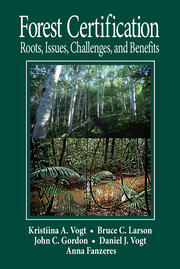
Forest Certification

Forest Certification: Roots, Issues, Challenges, and Benefits

Published:
Editor(s):
Free Standard Shipping

Purchasing Options

Hardback
$125.95
Add to cart
ISBN 9780849315855
Cat# 1585
eBook
ISBN 9781420049459
Cat# E1585
 

Features

  • Analyzes the scientific basis for the structure of the forest certification protocols
  • Documents the roles of human values in the development of assessment protocols
  • Demonstrates how elements of existing protocols should be used to produce non-value based standards
  • Discusses the success of the different sets of standards in assessing the environmental acceptability, social benefits and economic viability of the managed system
  • Covers the difficulty of certifying small landowners with current protocols.
  • Summary

    Forest certification has been widely accepted as a tool that would encourage industrial and non-industrial management of resources in an environmentally acceptable, socially beneficial and economically viable manner. Much has been written on certification yet five issues have been missing, which this book addresses: an analysis of the scientific basis for the certification standards; a formal and mechanistic incorporation of social and natural system sustainability as part of the standards; the rationale for the different sets of standards that are currently being used to certify governmental, industrial and non-industrial organizations; the success of the different sets of standards in assessing the environmental acceptability, social benefits and economic viability of the managed system; and, the difficulty of certifying small landowners with current protocols.
    Forest Certification examines the historical roots of forest certification, the factors that guide the development of certification protocols, the players involved in certification, the factors determining the customers to be certified, and the benefits of certification. The book also covers the terminology and other issues intrinsic to certification that direct the structure of standards, the similarities between indicators of different human disturbances within the ecosystem/landscape and certification standards, and, finally, a case study evaluating the strengths and weaknesses of existing certification protocols.
    Forest Certification is unique in its analysis of the scientific basis for the structure of the forest certification protocols. It documents the roles of human values in the development of assessment protocols but demonstrates how elements of existing protocols should be used to produce non-value based standards.

    Table of Contents

    ISSUES IN FOREST CERTIFICATION
    Improvements Crucial to Successful Implementation of Forest Certification
    Why Certification is Relevant
    ROOTS OF FOREST CERTIFICATION: ITS DEVELOPMENTAL HISTORY, TYPES OF APPROACHES, AND STATISTICS
    Origins of the Concept of Forest Certification
    Other Relevant Initiatives in Forest Certification
    The Certification of Environmental Claims in Industrialized Countries
    Analysis of Forest Certification Approaches
    Current Statistics and Characterization of Certified Forests by Ownership Type and Land Area
    DEFINITIONS AND CURRENT VALUES INTEGRATED INTO CERTIFICATION PROTOCOLS
    Defining Terminology
    Value-Laden Issues of Certification
    CASE STUDY AND EVALUATION OF THE DOMINANT CERTIFICATION PROTOCOLS
    Relevance of Toumey Forest to Assess Certification Protocols
    Analysis of the Elements Comprising the Dominant Certification Protocols as structured in January 1998
    Case Study: Student Evaluation of Protocols at Yale's Toumey Forest
    INDICATORS RELEVANT FOR INCLUSION IN ASSESSMENTS: TYPES, MINIMUM NUMBER, AND THOSE DERIVED FROM NON-HUMAN VALUES
    Indicators Selection Criteria
    Non-Value-Based Parameters Relevant for Incorporation into Certification
    Social Legacies Constraining Natural Resource Uses
    DIRECT AND INDIRECT IMPACTS OF NATURAL RESOURCE MANAGEMENT PRACTICES ON THE ECOSYSTEM
    Introduction
    Forest Management Activities Leading to Regeneration
    Forest Management Activities Not Associated with Regeneration
    Infrastructure Related to Forest Management Activities
    Summary
    SYNTHESIS DISCUSSION OF ISSUES RELEVANT TO CERTIFICATION
    Necessity of Assessing the Landscape's Matrix Within Which a Management Unit is Embedded
    Social and Natural Science Links
    Public Participation in Certification
    Importance and Participation of Non-Industrial Private Forests
    Certification: Constraints and Opportunities for Non-Industrial Private Forest Landowners
    Estimating Price Premiums Necessary to Pay for Forest Certification
    Chain of Custody as an Impediment to Certification
    Challenges and Opportunities for Tropical Timber Certification: Mexico's Experience
    CHALLENGES AND BENEFITS OF CERTIFICATION
    Summary Discussion of the Advantages and Challenges of Certification
    Reason for Forestland Owners Not To Become Certified
    The Past and Future Goals of Certification


    Editorial Reviews

    "…provides a valuable comparison of certifying organizations and their protocols. In addition, it clearly acknowledges that many of the issues underpinning forest certification are, like forestry itself, value-laden products of our own emerging understanding if the social and ecological systems that make up natural resource use and management. As such, it provides valuable advice to both certifiers and landowners."
    -Dr. Steven R. Radosevich in Forest Science

    Promo Copy

    Textbooks
    Other CRC Press Sites
    Featured Authors
    STAY CONNECTED
    Facebook Page for CRC Press Twitter Page for CRC Press You Tube Channel for CRC Press LinkedIn Page for CRC Press Google Plus Page for CRC Press
    Sign Up for Email Alerts
    © 2013 Taylor & Francis Group, LLC. All Rights Reserved. Privacy Policy | Cookie Use | Shipping Policy | Contact Us