
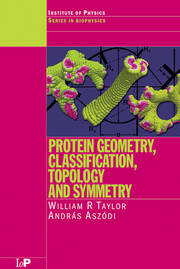
Protein Geometry, Classification, Topology and Symmetry

Protein Geometry, Classification, Topology and Symmetry: A Computational Analysis of Structure

Series:
Published:
Author(s):
Free Standard Shipping

Purchasing Options

Hardback
$109.95
Add to cart
ISBN 9780750309851
Cat# IP603
eBook
ISBN 9781420033632
Cat# IPE603
 

Features

  • Lays the groundwork for protein structure and geometric methods, creating a foundation on which later, more technical chapters can build
  • Applies these methods to reduce proteins to simple stick figures that allow secondary structure packing to be easily analyzed
  • Develops more elaborate methods for the structure of b-sheets based on the recursive tiling of a simple twisted surface
  • Reviews methods for protein structure comparison concentrating on those that are suitable for comparison of distant similarities
  • Covers common clustering methods and the alternative pigeonhole approach of allocating protein structures to a position in a "periodic table" constructed by idealized stick figures
  • Explores current protein topology and develops a method that gives more interesting results for proteins
  • Summary

    Using a geometric perspective, Protein Geometry, Classification, Topology, and Symmetry reviews and analyzes the structural principals of proteins with the goal of revealing the underlying regularities in their construction. It also reviews computer methods for structure analysis and the automatic comparison and classification of these structures with an analysis of the statistical significance of comparing different shapes. Following an analysis of the current state of protein classification, the authors explore more abstract geometric and topological representations, including the occurrence of knotted topologies. The book concludes with a consideration of the origin of higher-level symmetries in protein structure.

    The authors focus on simple geometric methods that are deterministic rather than probabilistic and on the more abstract simplifications of protein structure that allow a better understanding of the overall fold of the structure. Most of the methods described in this book have corresponding computer programs. These can be found (as C source code) at the ftp site of the Division of Mathematical Biology at the National Institute for Medical Research. This collection of ideas contains pedagogical material that make it ideal for post-graduate courses as well as new ideas and results essential for researchers investigating protein structures.

    Table of Contents

    INTRODUCTION
    Prologue
    Basic Principles of Protein Structure

    GEOMETRY
    Ellipsoids and Embedding
    Geometric Representations of Structure
    Distance Geometry
    Sticks to Strings
    Secondary Structure Geometries
    Simplified Architectures
    Sheets and Barrels
    Beta-Sheet Geometry
    Beta-Barrels

    CLASSIFICATION
    Networks and Domains
    Hydrogen-Bond Networks
    Protein Domain Definitions
    Protein Structure Comparison
    Overview of Comparison Methods
    Assessment of Significance
    Classification and Fold Spaces
    Protein Structure Classification
    Protein Fold Spaces
    A "Periodic Table" for Protein Structures
    Evolutionary' steps in fold-space

    TOPOLOGY
    Folds, Tangles and Knots
    Topology and Knots
    Random Walks in Fold-Space
    Protein Fold Complexity
    Structure Prediction and Modelling
    Random Folds from Distance Geometry
    Modelling with Distance Geometry
    Protein Tertiary Structure Prediction

    SYMMETRY
    Structural Symmetry
    Symmetry
    A Fourier Analysis of Symmetry
    Evolution and Origins
    Evolution of Structure and Function
    The Origins of Proteins
    The Secret of Life

    References

    Index

    Editorial Reviews

    "[This book] is a high quality concept book that can be used as a textbook for students and researchers interested in theory and computer simulation of polymers. The editors invited the leading exprets in their fields … . … I highly recommend this book to all readers interested in computer simulations of polymers."
    - Polymer News

    Textbooks
    Other CRC Press Sites
    Featured Authors
    STAY CONNECTED
    Facebook Page for CRC Press Twitter Page for CRC Press You Tube Channel for CRC Press LinkedIn Page for CRC Press Google Plus Page for CRC Press
    Sign Up for Email Alerts
    © 2013 Taylor & Francis Group, LLC. All Rights Reserved. Privacy Policy | Cookie Use | Shipping Policy | Contact Us